Finch’s law office was cozy and cluttered. My Democratic party friends spoke highly of him. In their opinion he was clean, honest, and open-minded—damn near a liberal. Nixon’s friend from his early career, he knew how to manage his penchant for paranoia. After the 1968 election he didn’t stay long at HEW but served as Nixon’s personal counselor for a few years before returning to private life.
Disgusted with what politics had done to his old friend, he side-stepped Watergate because he didn’t like the “Germans,” Haldeman and Ehrlichman. He believed that their sycophancy had facilitated the destruction a great man.
“Nice of you to see us,” I said. “I believe you know why we’re here.”
“First tell me about yourselves.”
Garland said, “I was a closeted gay urologist, who came out and left practice for the art world. I don’t know what Pasadena people think is worse, leaving my wife and children to live with my partner or leaving medical practice.”
Finch smiled, “I suspect being a gay urologist made some folks nervous.”
“Like a hetero gynecologist? Until recently women weren’t accepted in most medical specialties. Gay or straight, medicine remains an Old Boys club.”
“Point taken.” Finch said. “And Jerry, you taught at Muir?”
“Until last year. Now I’m at Merrill-Lynch, figuring out the stock market. After my divorce, I saw no future in teaching.”
“I understand that you were a delegate to the last three Democratic National Conventions. Are you going this year?”
I shook my head. “Lambs to the slaughter. No one has a chance against Reagan.”
Finch laughed. “He’s an ideal candidate, docile, pleasant, and he reads his lines well. Most Americans love him—including a lot of Democrats.”
“That really hurts,” I said, “Because it’s true.”
Garland said, “I’m not political. You know why we’re here.”



“Frank Armstrong called me. He likes your idea but thinks it won’t work here.”
I said, “You’re on the Board of Huntington Memorial, what do you think?”
“This town takes its cues from the President, and he’s imposed radio silence on the subject of AIDS.”
“Is he pandering to Bible-thumping fundamentalists?”
“Of course, they’re a key element of his coalition. The so-called moral majority abhors homosexuals. He needs their votes. Pat Robertson doesn’t want money put into a cure—he says that we should quarantine the gay folks. Ron is prudish, uncomfortable with homosexuality from his days in Hollywood. He’ll channel the evangelicals—if he ever speaks out on AIDS at all.”
“If you were Secretary of HEW, what would you do?”
“Like the War on Cancer, make AIDS research a top priority. Immediately publicize public health interventions. I spoke with Merv Silverman in San Francisco, and he identified common behaviors that spread the disease.”
“Bath houses, for sure,” Garland said. “If government closes them down it will be counter-productive, marginalizing people at risk. We need gay men to voluntarily curtail high risk behavior.”
“Many of the good citizens of this community would like to isolate gays—or shoot them,” I said. “I’ve heard that some healthcare workers won’t care for AIDS patients. I’m getting heat at work for my de minimus involvement.”
“All Saints is talking about a service center to provide psychological support and coordinate medical access.”
I said, “I want to set up a charitable trust. There’s no question in Pasadena we need community services for AIDS victims. There’s no blood test, no treatment, and no leadership in Washington. All we can do is coordinate care among the few doctors that will see AIDS patients and ultimately refer patients to Hospice of Pasadena.”
“It’s a tall order to educate the public about AIDS,” Finch said. “Ignorance, prejudice and superstition are powerful. It’s critical to share scientific information, such as any is available. A public health campaign from the CDC is a first step.”
I said, “The President should set a conciliatory healing tone, not wrathful biblical judgement.”
Garland said, “It seems that a lot of people want gays wiped out and would do nothing about the disease if there weren’t a threat that it might spread to straight people.”
“I’ve met with Dr. Anderson, our best infectious disease specialist. Coordinating care—simply identifying doctors that will treat AIDS is challenging. The few doctors that do it are burned out.”
“I’ll bring it up at the next Board meeting at Huntington,” Finch said. “The hospital isn’t flush with cash for something like this.”
“This is complicated. Maybe I’ll donate to All Saints and walk away.”
“That’s a good idea,” Finch said. “I don’t see a constructive response to your wishes. George Regas has enough political traction to move forward. You don’t.”
“What about your dream?” I asked. “Don’t you want to honor Irv’s memory?”
“My money is a drop in the bucket compared to federal dollars.”
“Don’t be impatient,” Finch said. “It’s a funny town, generous, kind hearted and yet an ugly history of bigotry. Only in the past ten years have Jews been welcomed on staff at Huntington—and black doctors still go to St. Agnes.”
Garland said, “I’m in a hurry to make a difference. I want to pick up a sign and shout at Reagan to get on the ball. Can you believe I voted for the guy?”
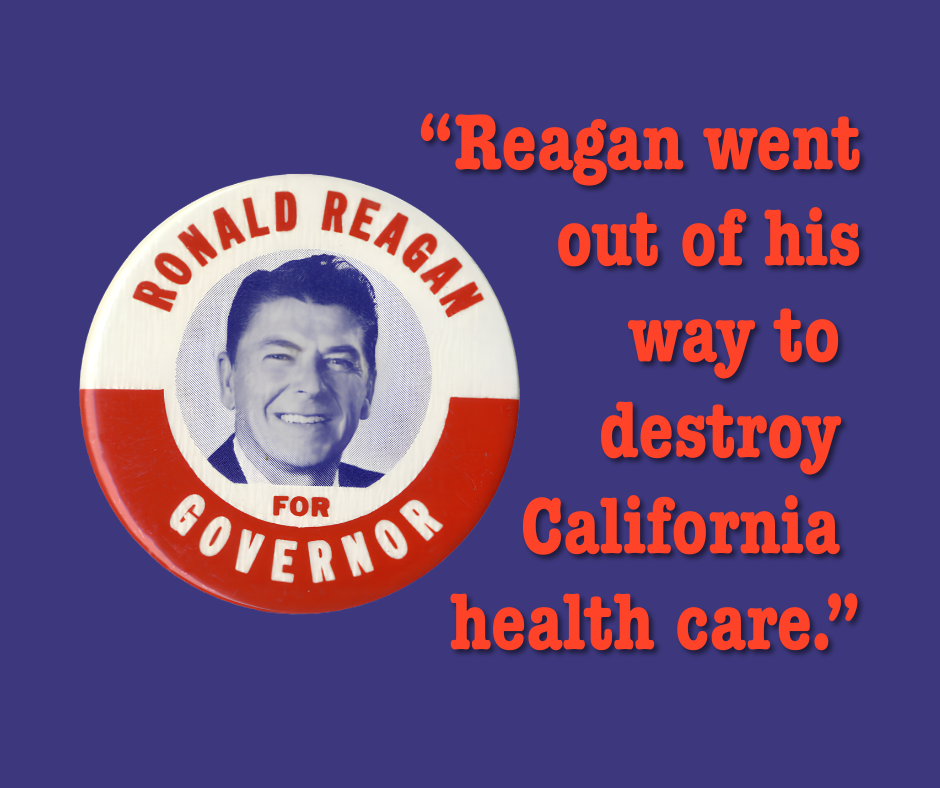
“Were you asleep when he was governor?” I asked. “Reagan went out of his way to destroy California health care.”