Thinking About Drug History
A personal glimpse at humane drug policy that preceded the War on Drugs
In June of 1967, at the end of my second year of medical school I obtained a small NIMH research grant to study drug rehabilitation in California. I wandered through The Summer of Love and had no idea how special this experience would be. At the peak of Flower Power, four years before Nixon’s War on Drugs bolstered punitive drug policy I witnessed efforts to transform drug rehabilitation from criminal punishment to medical treatment
Of note, John Ehrlichmann later admitted that the intent of the Controlled Substances Act (1971) was to intimidate blacks and hippies. Nixon wanted to cripple his core opposition. The basis of the law was the unscientific concept that drugs could be rated based on their “addiction potential.” Hence, it established five drug schedules ranging from five (minor risk) to schedule one (heroin, marijuana, and other problematic drugs).
This meaningless concept lacked a tool for measurement, relying on urban legend. But anyone can become addicted to drugless activities, food, gambling, sex, etc. All pleasant experiences have “addiction potential.” The societal effects of drugs are a consequence of prohibition not pharmacology. For example, Congress studied marijuana during World War Two and reported that it had minor risks, finding no evidence that it was a “gateway drug” to heroin use. (La Guardia committee Report 1944). Punishment was a Puritanical atavism. As late as the 1950’s Congress considered mandatory death sentences for drug trafficking.
Following recognition of alcoholism as a disease in the fifties, medically treating heroin addiction was next. In the sixties Dole and Nyswander opened methadone maintenance clinics to uncouple anti-social behavior from drug consumption. Maxwell Jones applied his idea of therapeutic communities to substance abuse, consulting with California to develop a system of civil commitment in lieu of felony convictions, helping to create the California Rehabilitation Center (CRC) in Norco as a therapeutic community.
As part of my research project, I visited CRC and met with the facility’s research director, John C Kramer, MD. He had found evidence of benefit, and his associate, Douglas Anglin, PhD later published their data showing modest recidivism prevention. I met with the program’s administrators and half a dozen inmates whose foremost complaint was that the duration of treatment was too long, usually seven years. When this became widely known drug criminals opted for conventional incarceration with shorter sentencing.
Jones’ system used lay therapists, who were employees of the corrections system and he intentionally excluded health professionals. In the 1970’s correctional staff rebelled against “coddling drug addicts” and eventually shut down the therapeutic program. Dr. Kramer left for a faculty appointment at my alma mater, UC Irvine. Anglin moved on to UCLA and popularized strategies of legally imposed drug treatment.
My project took me to San Francisco where I briefly volunteered at the Free Clinic. David Smith’s program was largely aimed at LSD and amphetamine, but they provided a walk-in medical clinic during the Summer of Love. I gave medical care within the limits of two years of med school. During the summer organized crime moved in on the psychedelics market introducing methamphetamine into Haight-Ashbury, strong-arming dealers to sell speed. A reluctant hippie-dealer was sliced up and tossed in the Bay.
Smith’s preferred approach to LSD “bad trips” was drugless. We talked the kids down. Their hallucinations were distorted inner projections. If they kept their eyes open the unpleasant experiences quickly dissipated. However, the kids that were “freaked out” on speed required a slug of Thorazine and a trip to Napa State Hospital. No talking down someone in the grips of paranoid delusions. (Charley Manson picked on those kids, following them and whispering threats into their ears until they went nuts).
David Smith arranged visits with the faculty at UC San Francisco. Frederick Meyers, MD, who had identified a new psychedelic, STP was generous with his time. Prophetically, I heard about an opioid “as potent as LSD,” active at microgram doses (Sublimaze aka fentanyl). He was pessimistic, saying that their research would soon be shut down because law enforcement didn’t want them to find efficacious uses for drugs like heroin and LSD.
“There are four interest groups that will make sure our efforts are frustrated: First, law enforcement. Drug laws are a make-work project for police. (The marijuana laws were written to provide work for unemployed alcohol enforcement officers during the Depression). Secondly, politicians need non-voting scapegoats. Third, banquet circuit scientists, who (for a price) provide rationalizations for anti-drug laws. Fourth, the drug cartels’ profit margin flows from the risk premium on contraband drugs.” [Meyers 1967]
Having read Lewis Yablonsky’s book I tried to squeeze in Synanon. I visited their headquarters on Venice Beach. It didn’t work out. Finally trapping Chuck Dederich at their annual ball, I got a few minutes of his time and was told I had to contribute thousands of dollars to the program and participate in the “game” if I wanted to learn more. Otherwise, they had no interest in sharing their work with a medical student.
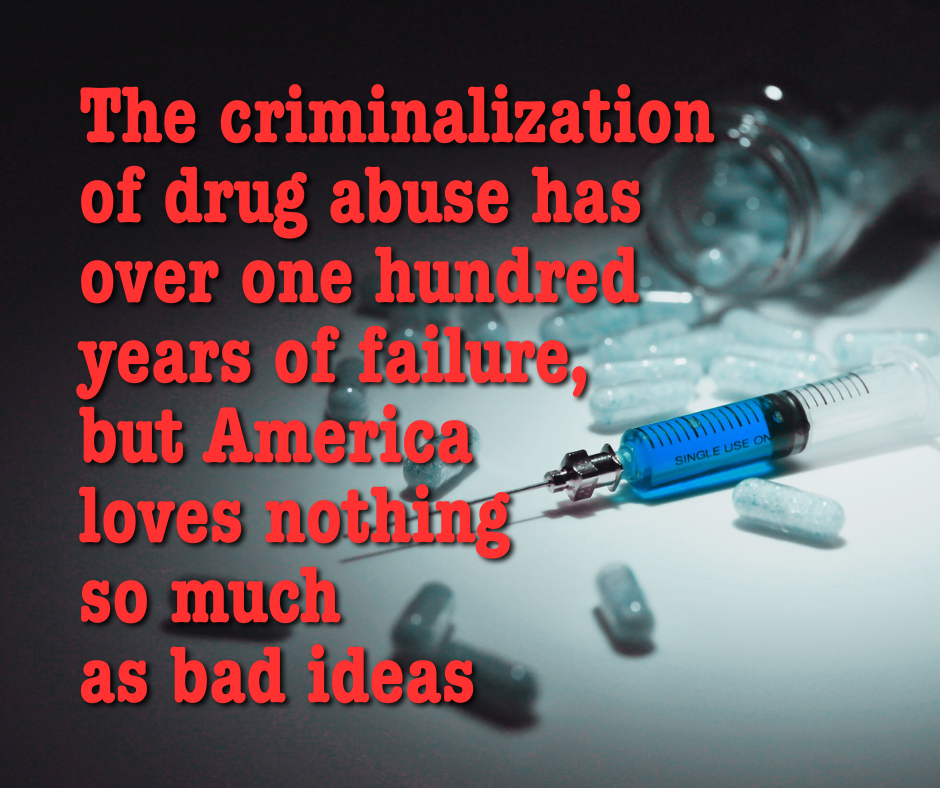
The sixties offered a respite from punitive approaches to drug addiction but political opportunism won out, putting the criminal justice system back atop substance use disorder. Since then, America has tacked on fifty more years to the folly that began in 1915 with the Harrison Act. The criminalization of drug abuse has over one hundred years of failure, but America loves nothing so much as bad ideas.
I was blessed to witness a special era of optimism and kindness, long forgotten efforts to replace punitive drug policy. Fortunately, I have lived long enough to tell about it.
Henry Rex Greene Henderson, NV
12/30/2025